By
By
When does treatment demand really rise and fall? To find out, we compared Recovery.com’s own search data with three years of public data from Ahrefs and Google Trends. What it shows may change how you plan your budget.
The bottom line: don't cut your budget
Seasonal dips are real, but they're not a reason to pull back. If you pay per result, lower search volume doesn't raise your cost per admission. You simply get fewer results that month, and holding your budget means you capture every admission that's still out there. If empty beds are your bigger worry, the lower months are exactly when added spend does the most to protect census.
The rest of this report shows why.
The three things to know
1. Seasonality is real
.png?width=3200&height=1800&name=Search-Demand-Through-the-Year%20(1).png)
Demand rises and dips through the year, and both datasets show it. Recovery.com activity peaks in January, dips in July, rebounds in September, and hits its low in December. Public search data moves too, within a narrower band. Planning as if every month is the same leaves admissions on the table.
2. The swings aren't dramatic
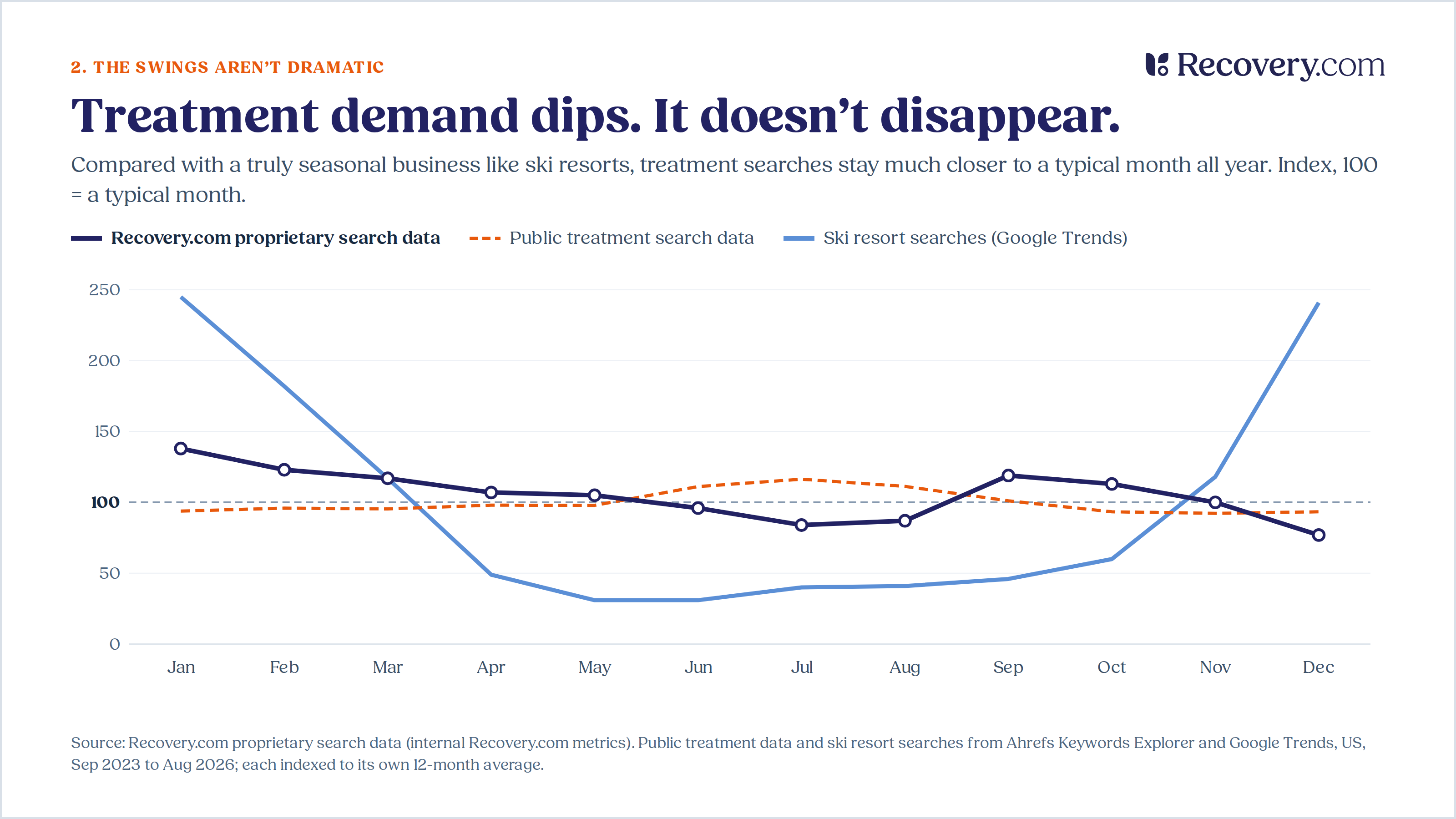
Even the lowest month is a dip, not a drop-off. Compare treatment with a truly seasonal business like ski resorts: in Google Trends, ski resort searches fall to about a third of a typical month in late spring and summer, then climb to more than twice typical in winter. Recovery.com's slowest month still holds about three-quarters of typical demand, and public treatment searches never fall below about 90%. Your slow months still bring in people looking for care.
3. Budgets don't have to change
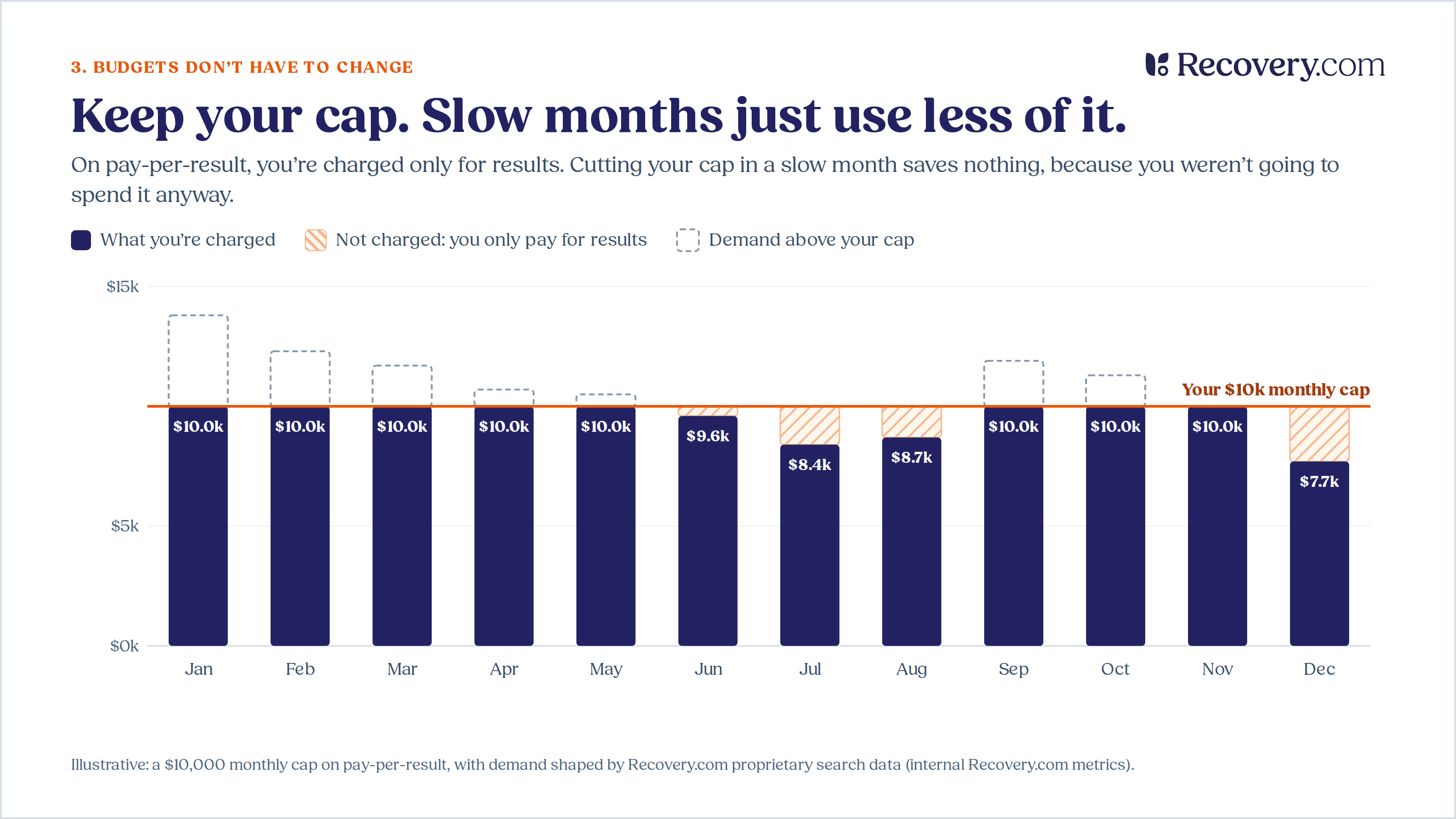
On a pay-per-result model, your cost per admission stays the same whether volume is up or down. Spend rises and falls on its own with the results you get, so there's nothing to cut. Holding your budget steady lets you capture more of the demand that's still there.
One question worth asking your own data: when search volume dips, does call quality dip too, or just call volume? If quality holds, a slower month costs you nothing extra on a pay-per-result model.
What it means for your ad budget
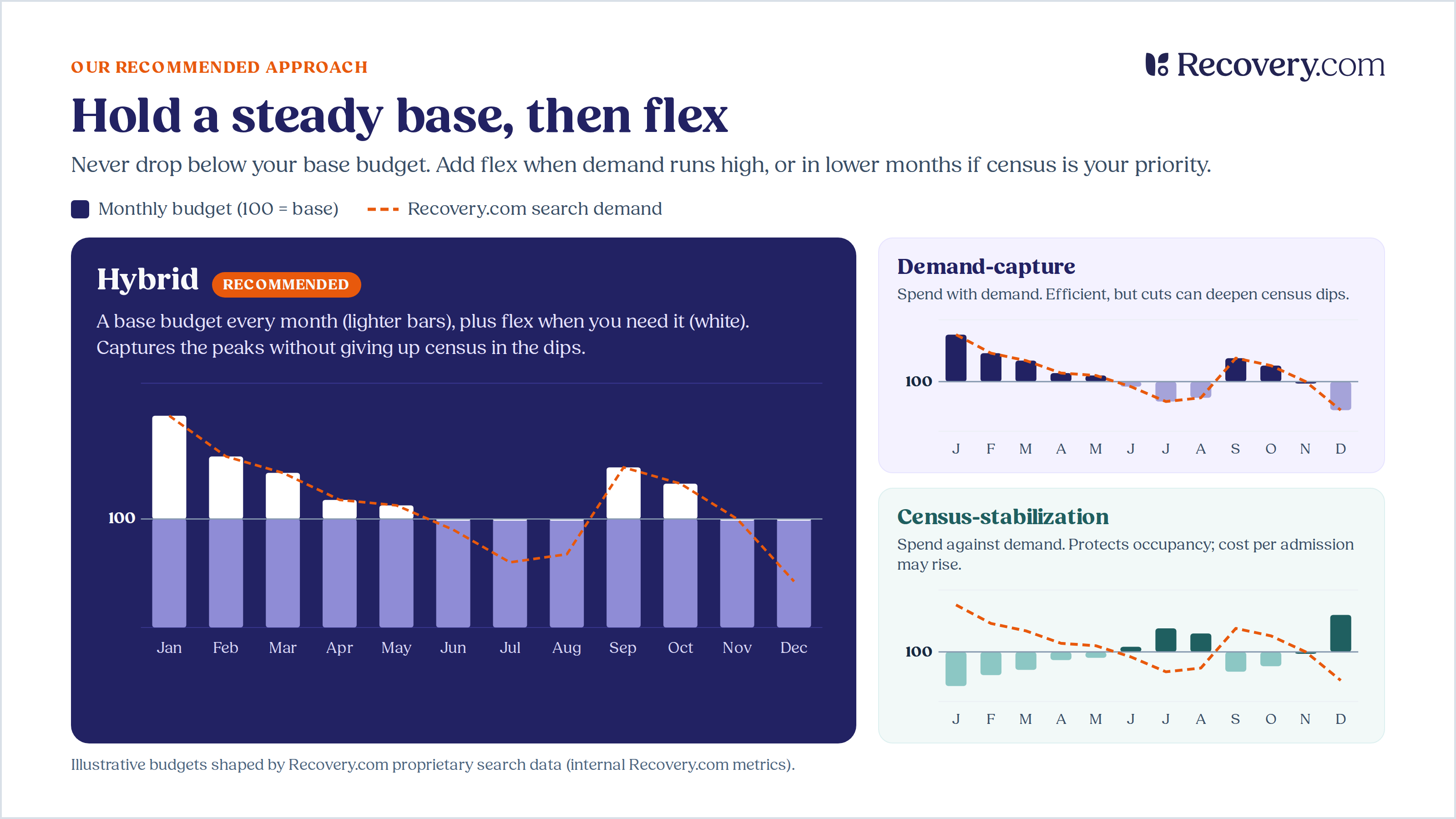
For most centers, the best plan is a hybrid. Keep a base budget running year-round and never drop below it, then add seasonal flex when you need it: more budget when demand runs above typical to capture the peaks, and more in lower months if census is your priority.
Two other approaches fit specific situations:
- Demand-capture adds budget when demand is high and pulls back when it dips. It's efficient, but cutting in lower months can deepen census dips.
- Census-stabilization holds or raises spend in lower months to win more share of a smaller market. It protects occupancy, though cost per admission may rise if you aren't paying per result.
More spend isn't the only lever. Better bids, broader geography, stronger creative, or new channels can also close the gap. And if you buy on a cost-per-acquisition basis, you don't have to change your budget at all.
Month by month: what moves demand
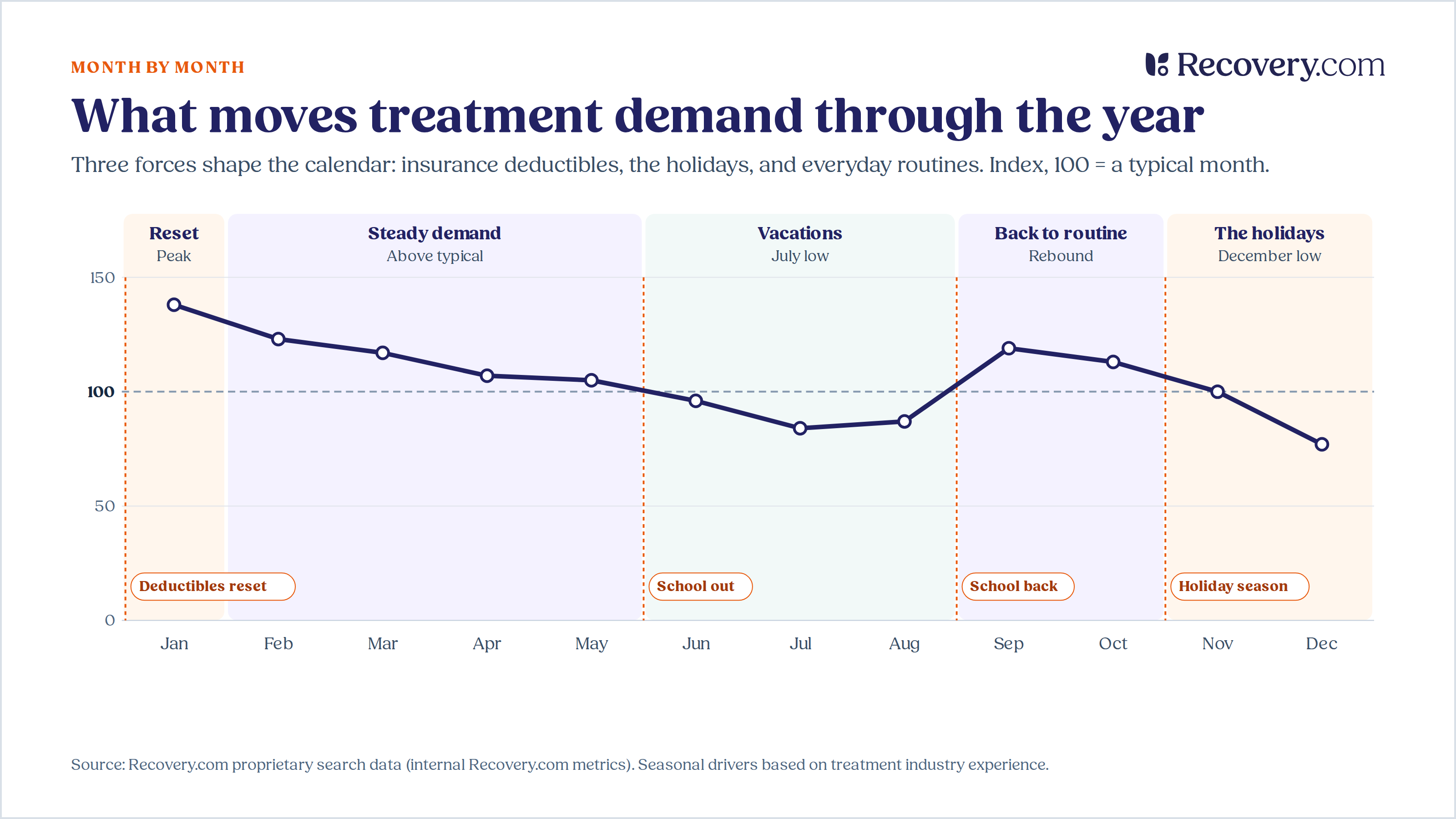
Seasonality is real, and it shows up most in a few stretches of the year. Three forces shape the treatment calendar: insurance deductibles, the holidays, and everyday routines. These are the months worth planning around.
January: deductibles reset. Most calendar-year plans reset on January 1, so out-of-pocket costs are at their highest just as many people are most motivated. Post-holiday fallout and New Year's commitments push people to act anyway, and Recovery.com search activity peaks for the year. Expect more questions about cost, and make sure your team can explain payment options clearly.
February to May: steady, above-typical demand. January's momentum eases gradually through spring. With few calendar disruptions, this is a good stretch for consistent spend and for testing new campaigns.
June to August: vacations and summer routines. Recovery.com activity reaches its low point in July as people travel and put planned treatment on hold. Public search data shows a modest summer lift, so people are still researching even when fewer are ready to commit. Programs that serve teens tend to feel this dip most, since their referrals follow the school calendar.
September and October: back to routine. As work and school schedules return, Recovery.com activity rebounds above typical. By October, people who have already met their deductible start looking to use their benefits before the reset.
November and December: the holidays. This is a hard stretch for many people. Family gatherings, more drinking, financial stress, and winter-pattern depression pile up, yet many put off treatment until after the new year, and Recovery.com activity falls to its lowest point in December. At the same time, admissions teams are often at their thinnest, with vacations and holiday schedules leaving fewer people to answer calls. Plan holiday coverage for your admissions team so the people who do reach out aren't sent to voicemail. Anyone who has met their deductible also has a strong reason to start care before January 1.
How seasonality differs by level of care
.png?width=3200&height=1800&name=Level-Of-Care-Timeline%20(1).png)
Seasonality also looks different depending on the care you offer. The more planned the admission, the more the calendar matters. Detox responds to events, residential care responds to schedules and cost, and outpatient care fits around work and school.
Detox: event driven. Detox decisions happen fast and are often triggered by a crisis. Benders around holidays and big events often lead straight to detox, so watch the weeks after major holidays and early January.
Residential: the most planned. Families schedule residential care around holidays, vacations, school, and whether the deductible has been met. Watch the stretch before and after the holidays, the end of the school year, and the fourth quarter for people who have met their deductible.
Outpatient and IOP: routine driven. Outpatient care is built around work and school, so it shifts with routines more than seasons. It's often a step down from residential care, so it tends to follow residential demand by a few weeks. Watch September restarts and January routines.
How seasonality differs by clientele and state
Who you serve can matter more than the calendar itself. The clearest example is teen treatment, which tends to run opposite to adult demand in summer.
- Teens. Adolescent care follows the school calendar. Summer is often the slowest stretch because families travel together and school-based referrals stop. A CDC analysis of 2018 to 2023 emergency department data found youth mental and behavioral health visits made up a larger share during the fall and spring semesters than the summer before. A Boston Medical Center study found the same school-year pattern in outpatient care.
- College-age young adults. Summer and winter breaks bring students home, where parents are more likely to notice a problem. Expect inquiries around those breaks and pressure to finish care before the next semester.
- Adults. Adult demand is shaped more by insurance timing and the holidays than by school. Deductible resets in January and "use it before you lose it" decisions in the fourth quarter both matter.
- Substance use vs. mental health. Mental health programs feel the pull of winter-pattern seasonal depression, which usually starts in late fall or early winter and eases in spring. Substance use demand is tied more to holidays, events, and New Year's commitments.
- State. Patterns shift by geography. Warm-weather states may see winter visitors and seasonal residents, and payer mix and state insurance rules differ widely. A national index is a starting point; your own state's data is the better guide.
.png?width=2448&height=3168&name=CMO-Guide-Option-4-More-Space%20(1).png)
Methodology and sources
Recovery.com proprietary search data comes from internal Recovery.com metrics. Public search data combines US monthly search volume from Ahrefs Keywords Explorer and US weekly search interest from Google Trends for commercial residential addiction treatment terms, September 2023 to August 2026. Public volumes were summed across keywords, divided by a centered 12-month moving average, then averaged by calendar month so that 100 equals a typical month. Ahrefs volumes are modeled estimates, and terms that also capture physical rehab or mental health searches were excluded.
Special thanks to Dan Gemp, Brian Wind, Barry Reiman, and John Raymond for contributing their thoughts.