By
By

Marketing leaders in behavioral health rarely struggle to answer how much they are spending.
What they struggle with is knowing whether that spend is good.
Budgets get approved. Channels get funded. Agencies get hired. But benchmarks remain fuzzy. How many admits should come from referrals? How much budget should go to paid channels? When does organic become a real growth lever instead of a long-term promise?
To bring clarity to a space full of opinions and very few shared reference points, Recovery.com surveyed 13 senior behavioral health leaders, including operators, marketers, and growth partners. We asked six focused questions designed to reveal how experienced teams actually think about marketing mix, budget allocation, and conversion quality.
This article walks through all six questions, what leaders said, and what their answers reveal about what “good” really looks like in behavioral health marketing today.
Where Should Admits Come From?
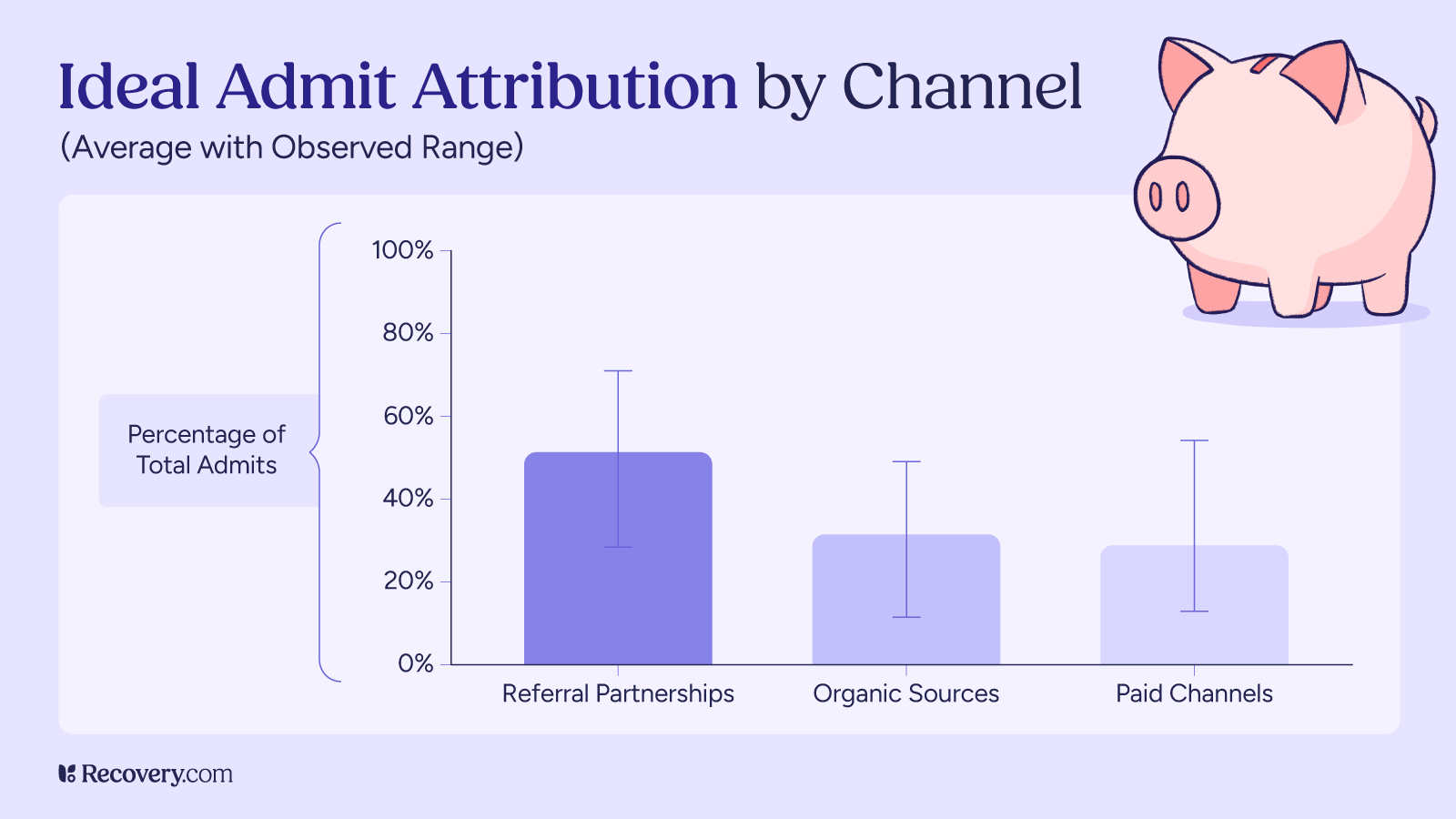
When asked to imagine an ideal scenario of 100 total admits, respondents showed strong alignment around one core belief: referral partnerships should anchor growth.
On average, leaders said 50% of admits should come from referral partnerships, 29% from organic sources, and 28% from paid channels. While these averages provide a useful anchor, the ranges matter just as much. Referral partnerships showed the widest variation, reflecting differences in execution maturity rather than disagreement about importance.
Organic and paid channels clustered more tightly. Organic was consistently viewed as reliable but intentionally capped, while paid was treated as supportive leverage rather than a foundation.
“The rationale is straightforward: organic and referral admissions consistently deliver the lowest CPAs. Paid advertising is an excellent channel, particularly depending on geography and levels of care, but it's best positioned as a safety net and a lever to pull based on census needs, rather than the foundation of your admissions strategy. The goal over time is to build enough brand equity and referral relationships that paid becomes supplementary rather than essential.”
George Kocher | Brand North
What this tells us: Leaders want growth rooted in trust first, then scaled through discoverability and demand capture.
What Assumptions Shape Channel Mix?
When respondents explained why they allocate admits the way they do, their answers were not tactical. They were structural.
Four assumptions consistently shaped their thinking:
- Market dynamics: Competitive and mature markets increase reliance on referrals and paid channels. Less crowded markets allow organic and referrals to carry more weight.
- Program size and stage: Smaller programs lean on paid for speed and referrals for early traction. Larger programs diversify out of necessity.
- Clinical acuity: Higher-acuity programs trust referrals more and broad discovery channels less. Lower-acuity and outpatient models see more viability from organic and paid.
- Payer mix: Insurance-heavy models require more credibility and longer qualification cycles. Private-pay models accept more volatility.
“Early-stage programs, new markets, or centers lacking brand authority will skew more heavily toward paid channels initially, even as much as 80%+. Over time, the goal should be to intentionally rebalance toward referrals and organic as authority, trust, and relationships are built.”
Derek Hyman | Scalable Growth
“In oversaturated markets like Los Angeles, generating professional referrals becomes more difficult. Programs in these areas typically need to rely more heavily on organic and paid digital channels to maintain admissions.”
Jeremy Manné | Altior Healthcare
What this tells us: Leaders are not describing marketing preferences. They are describing operational realities. Channel strategy is contextual, adaptive, and constrained by reality, not theory.
How Should the Marketing Budget Be Allocated?
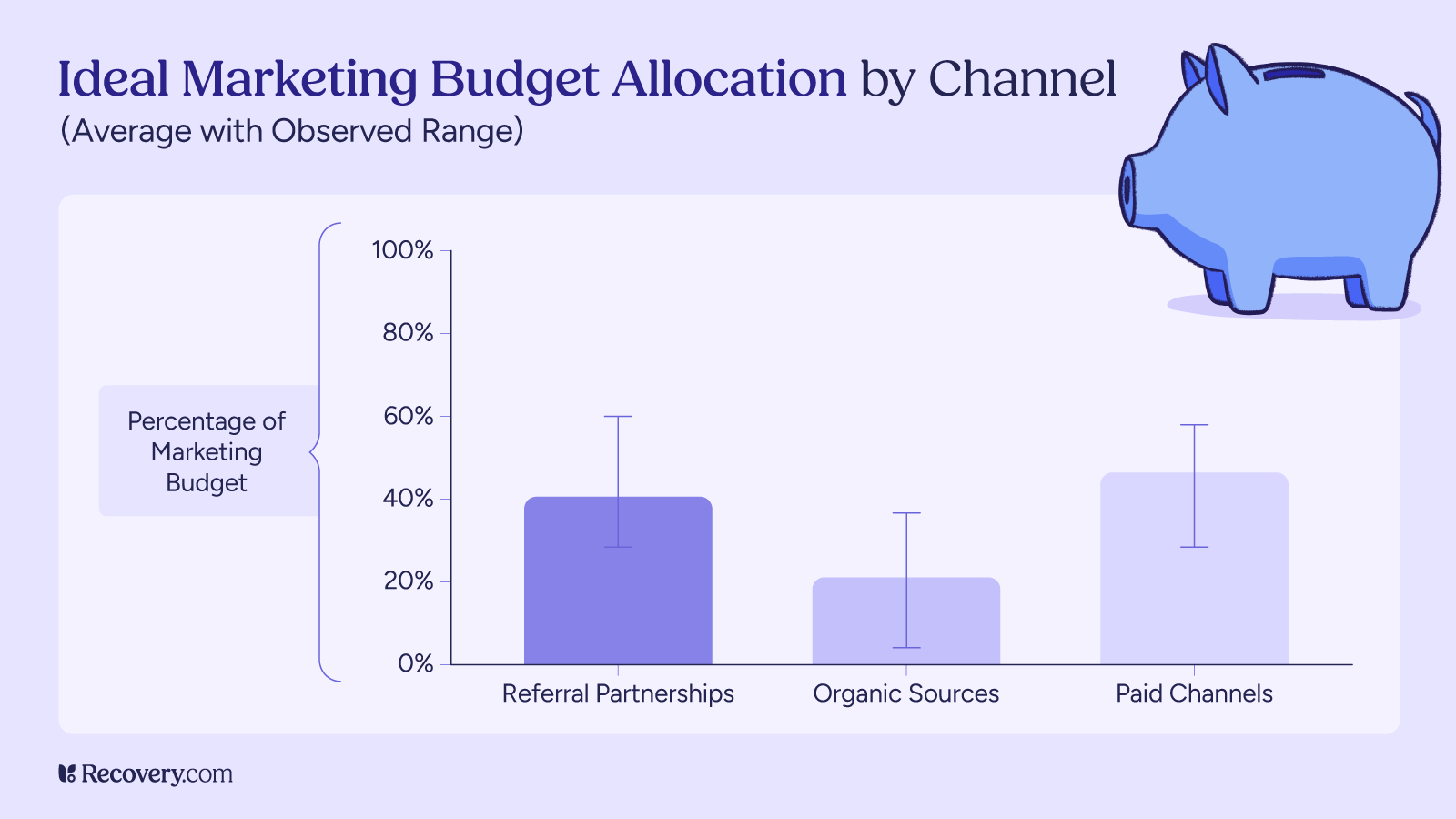
When leaders were asked how their total annual marketing budget should ideally be split, a clear tension emerged.
On average, respondents said 44% of budget should go to paid channels, 40% to referral partnerships, and 20% to organic. Unlike the admits mix, budget allocation skewed heavily toward paid, even among leaders who expressed skepticism about its efficiency.
This distribution reflects operational pressure more than preference. Paid channels are scalable and immediate, referral programs are strategic but labor-intensive, and organic is trusted as a long-term asset but takes a while to build up.
When compared directly to the ideal admits mix, the contradiction becomes clear:
- Referrals drive about half of ideal admits but receive less than half of the budget.
- Organic produces nearly a third of admits but receives about a fifth of spend.
- Paid produces less than a third of admits but absorbs the largest share of budget.
Paid channels play different roles depending on where someone is in their decision-making process. PPC and paid social are designed to generate volume by intercepting early or exploratory demand. Treatment navigation platforms like Recovery.com operate differently. They typically produce less volume than PPC, but the people arriving through these platforms are much farther along in their decision-making process, which consistently results in higher-quality, more admissions-ready inquiries.
What this tells us: Spend follows urgency and scalability, not necessarily confidence.
Where Is the Biggest Gap Between Spend and Admits?
When asked directly where money is most misaligned with performance, respondents were consistent.
Paid channels receive disproportionate spend relative to the quality of admits they produce. This was not framed as paid media failing, but as being overused as a default lever when growth slows.
At the same time, referral partnerships, alumni, and relationship-driven channels were repeatedly cited as producing higher-quality admits while receiving less structure, funding, and attention.
Attribution compounds the issue. Paid is easier to track. Referrals, organic influence, brand, and admissions execution are harder to credit accurately.
Several respondents emphasized that the real gap is not marketing at all, but operations.
What this tells us: Though organic and referral partnerships gain the majority of admits, they are harder to track, and therefore consistently underfunded.
How Do Channels Actually Convert?
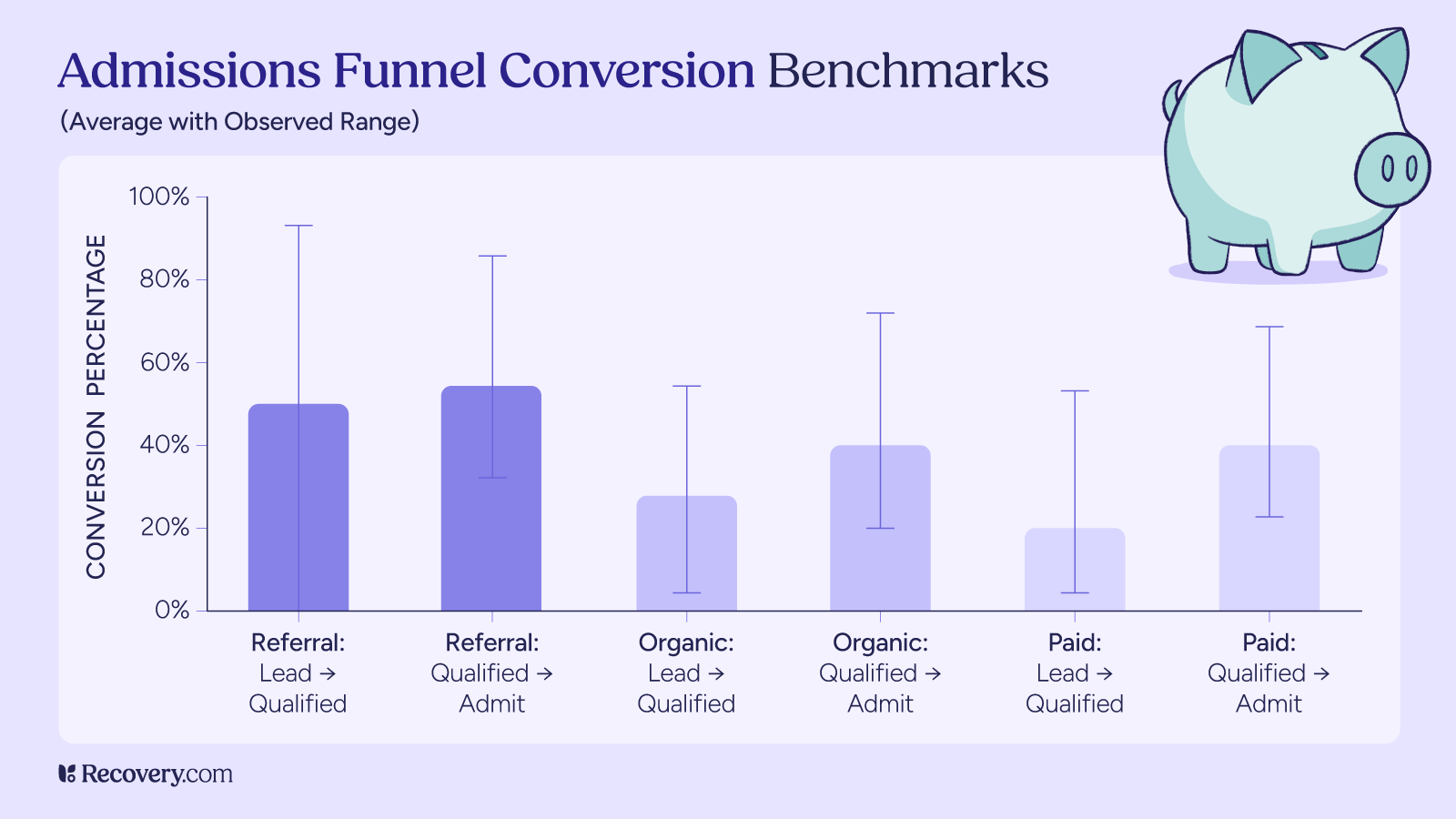
When respondents shared lead-to-qualified and qualified-to-admit conversion rates by channel, clear patterns emerged. On average:
- Referral partnerships converted about 50% of leads to qualified, and 55% of qualified leads to admits.
- Organic sources converted about 25% of leads to qualified, and 40% of qualified leads to admits.
- Paid channels converted about 20% of leads to qualified, and 40% of qualified leads to admits.
Referral partnerships outperformed every other channel at every stage of the funnel, though results varied widely based on execution quality.
Organic struggled earlier in the funnel but tightened significantly after qualification, suggesting intake quality matters more than traffic source.
Paid showed the weakest top-of-funnel quality, but once leads were qualified, its close rates nearly matched organic.
What this tells us: Most inefficiency happens before qualification, not after. Paid is a filtering problem, not a sales problem.
What Improves Conversion Across All Channels?
When asked to name the single factor that most improves conversion regardless of channel, leaders aligned strongly.
The answers were operational, not marketing-driven.
Speed to contact, consistent follow-up, admissions team skill, clear qualification criteria, and alignment between marketing promises and intake reality dominated responses.
Trust surfaced repeatedly as the underlying accelerator. Social proof, professional referrals, and clear clinical positioning matter more than channel mechanics.
Something that was missing from most leaders' answers was the focus on creating a quality website. At Recovery.com, it can be quite common that people are interested in a treatment center profile, but when they click on the website it is confusing, information scarce, or not compelling enough.
A benefit that treatment centers get when working with us is that the process of building out their Recovery.com profile actually improves how they market on their own website. High quality pictures, clear differentiation, and ample social proof only strengthen your conversion rate.
Since every channel usually involves coming to your website, investing in making it high quality is a rising tide that lifts all boats. We recommend a strong, conversion-focused checklist for every treatment center location page.
“We coach on ‘building a clinical alliance’ with admissions teams where the focus is the patient, their challenges, and how/if their treatment center is right for them. Only after that should you bring up insurance. This ensures that if they are the right fit for the program they are given the opportunity go there instead of being automatically disqualified because of their policy. This can often be tracked by average ‘talk time’. Intentionally increasing that KPI through training can help conversion across all channels. Also, most importantly, this helps the patients feel heard. Calling in when struggling and having somebody turn it into a financial discussion within the first 60 seconds can just add to the shame, guilt, and potentially dehumanization many of our clients are feeling when making that call. That's not good for them, and it's not good for the conversion at treatment centers.”
Steve Donai | Growth Sherpa Consulting
Core insight: The fastest path to better performance is not new channels. It is better execution after the lead arrives.
10 Key Takeaways
There is no universal definition of a good marketing mix in behavioral health.
But there are clear patterns:
- Referrals anchor sustainable growth. Across respondents, referral partnerships consistently produced the highest-quality admits and the strongest conversion at every stage of the funnel. Leaders believe referrals should account for roughly half of total admits, even though they are harder to scale and operationalize.
- Organic channels stabilize performance, not accelerate it. Organic sources such as SEO, content, and direct traffic are widely trusted, but intentionally capped. Leaders view organic as a long-term asset that compounds trust and credibility rather than a channel designed to carry short-term growth on its own.
- Paid media is necessary, but often over-relied on. Paid channels absorb the largest share of marketing budgets because they are immediate and scalable, not because they consistently deliver the highest-quality admits. Paid works best as a supporting channel, not as the foundation of growth.
- Spend does not naturally align with performance. Leaders believe referrals and organic should drive most admits, yet paid media commands the largest share of budget. This gap reflects urgency and execution constraints more than confidence in results.
- Channel effectiveness is shaped by context, not preference. Market competitiveness, program size, growth stage, clinical acuity, and payer mix materially influence which channels work. There is no universal “right” mix, only mixes that fit specific operational realities.
- Most inefficiency happens before qualification, not after. Conversion data shows that once leads are qualified, organic and paid perform similarly. The largest drop-off occurs at the top of the funnel, making lead quality and filtering far more important than closing tactics.
- Paid media’s core challenge is filtering, not selling. Paid channels struggle to produce qualified leads consistently, but convert reasonably well once leads are properly screened. This reinforces the importance of capturing higher-intent demand whenever possible.
- Operational execution matters more than channel choice. Speed to contact, consistent follow-up, admissions team skill, and clear qualification standards were cited far more often than any marketing tactic as drivers of conversion across all channels.
- Trust is the true conversion accelerator. Reputation, professional referrals, social proof, and clear clinical positioning consistently outperform tactical optimization. Channels amplify trust, but they do not create it.
- Recovery.com fits where intent is highest. Compared to high-volume paid channels like PPC, Recovery.com generates fewer leads but reaches people much further along in their decision-making process. This allows teams to improve lead quality, reduce wasted spend, and shift admissions effort from filtering to helping.
Survey Contributors
Below are leaders whose insights informed this research:
- Zach Gross — MGMT Digital
- Matthew Fung-A-Fat — ADVENT
- Daniel Krasner — Sero Mental Health
- Nolan O’Malley — Newport Healthcare
- George Kocher — Brand North
- Derek Hyman — Scalable Growth
- Nick Jaworski — Circle Social Inc.
- Steve Donai — Growth Sherpa Consulting
- Wade Muhlhauser — Plugged In Recovery
- Gary Garth — elev8.io
- Drew Powers — Fractional Chief Growth Officer
- Jeremy Manné — Altior Healthcare
- Daniel Henley — Red Rock Recovery Center